| NORTH AMERICAN BABYDOLL SOUTHDOWN SHEEP ASSOCIATION & REGISTRY | ||||
 |
 |
 |
 |
 |
| Start your day with a SMILE...Own a BABYDOLL! | ||||
| NORTH AMERICAN BABYDOLL SOUTHDOWN SHEEP ASSOCIATION & REGISTRY | ||||
|
|
|
|
|
| Start your day with a SMILE...Own a BABYDOLL! | ||||
If you plan on showing your sheep or would like to be able to move your sheep around the farm easily, then teaching your sheep to lead will be helpful. It's always helpful to have a friendly sheep but sometimes it isn't the case. A good way to friendly-up any sheep is to call it with a grain bucket. Some learn to come running pretty quickly. Get them used to being touched and scratched all over while giving them a little treat and then slip on a halter. However, some just need to be caught and a halter slipped on.
Once you get a halter on them, tie them to a stationary object and walk away to let them figure out for themselves about pressure, giving in to it, etc., on their own. Most sheep will catch on quicker, and learn faster, just being tied up and left alone to figure out the rope; 20 -30 minutes sessions are a good start. Of course, never get out of sight of them just in case they get into trouble, get a leg hung in the rope, or flip upside down and need assistance. Find something else to do, close to them, while they are learning so they also get used to the activity around them.
When left tied, they will pull for a while. After a bit, they get tired, they take a step forward and discover they get relief from the pressure. If you walk toward them, they pull back again, causing pressure. If you step away, they relax, releasing pressure. Keep repeating the step toward, step away routine. They soon learn giving in to the pressure of the rope gives them relief.
Once they have been tied for several hours over a couple of days, and you feel they are ready, start leading them. Use a longer rope as to not be really close to them to panic them. Pull enough on the rope to cause a steady pressure. As soon as they walk forward, or even jump, give extra slack in the rope. Give them a few seconds then apply pressure on the rope again. They soon learn when you pull they should walk forward.
After a little time, depending on the sheep, you should be able to get closer and closer to them until they will walk by your side. The next step is to teach them to walk beside you when you walk, and stop when you stop. After a few lessons you should be able to start touching and handling them. By this time they should be more comfortable around you and accept the handling fairly well. You can do more with them as they can accept it. Eventually, lambs can be led away from the flock and become accustomed to being alone. It can be helpful to lead the lambs on some gravel or rocky area as well as concrete. Many fairs do have concrete isles and show rings. If an animal has not walked on concrete, they tend to put on the brakes and not walk in a natural fashion.
Your goal should be a 20-minute walk with its head held high. This is about the amount of time you would spend in a show ring. With time you can practice setting up the lamb with its head in a natural position with the neck held straight up from the shoulders and legs placed under each corner of the body. Lambs may not like to have their legs moved by hand, but with practice, they will accept having their legs moved into proper position. Exercising your lamb will help you build a bond with them as well as condition your lamb. Always end on a good note and stay in control until the halter is removed and the lamb is returned to its area. A lamb allowed to get away, may try it again next time.

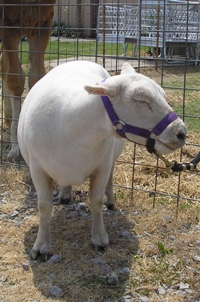
There are several different types of halters to use when training. The most common type is braided nylon rope type halters. They are fully adjustable and will fit any size sheep by simply adjusting the rope to fit the head size. The only thing with these types of halters when using them to halter train, when you pull on them, or the sheep pulls back, they do tighten up and can panic an already frightened sheep. The pressure does not release off of the face very well, unless you use your hands to loosen it. This type of halter is better for sheep already trained to lead; one not likely to be pulling backwards as an untrained or wild sheep would. Other choices for training are the flat nylon halters similar to other livestock halters but sized for small sheep. They can have a figure 8 under the jaw, or just the flat nylon halters for miniature horses or alpacas work well. This type provides relief to an animal and loosens easily when slack is in the lead rope when teaching an animal to lead.
If you plan on entering your sheep in a Breed Class you may choose to invest in a leather show halter. If you plan on entering a Fitting and Showmanship class, a halter should not be used unless you are younger in age. This is because in breed classes they judge your sheep and in fitting and showmanship classes they judge how you have prepared your sheep (fitting) and how well you handle it (showmanship).
Let's start by saying, YES! YOU CAN SHOW A BABYDOLL Southdown. Olde World Style Southdowns were the rage of the 1960's show and market classes before they were selectively bred to become the taller leaner modernized American Southdown you see today. Olde World Southdowns have since been renamed BABYDOLL Southdowns to distinguish the difference. We refer to this unchanged heritage breed as the BABYDOLL Southdown sheep since they have become an established North American breed once again.
Although they may not meet the weight requirements of today's market classes they are still a good choice to show in fitting and showing classes, wool classes, and especially with young showmen not old enough to sell a market animal or who do not want to say goodbye to their project at the sale. Their naturally small size and docility make them a good choice for showman of all ages.
A sheep whose structure
(conformation) is better than average should be
selected. Pluses in the show ring include:
A sheep who best conforms to the breed standard and breed type (good
thick muscling, good square leg set, good bone, nice level head with
blended ear set, nice breed muzzle, wide and not snippy or roman nose,
flat top line with a high tail head, wool of Southdown quality, last
rib to rump slightly longer than last rib to shoulder, laid in
shoulder, thick, wide and long loin length, well muscled rear (twist
and legs) etc. A traditional off-white sheep with good muzzle and leg
hair pigment is exceptionally showy although solid blacks are allowed.
Blacks with even color are preferred to the faded blacks (most blacks'
fleece fades) with darker legs.
Please refer to the NABSSAR Breed Standard for additional help in selecting the ideal show sheep.
 |
 |
| © NABSSAR 2001-2026 |